Showing posts with label non-fiction film. Show all posts

Sunday, May 4, 2008

I'm boycott-crazy

As I may have intimated, the quadrant of my brain that contains all my political guilts has recently (again) been tickled. Every year that I've attended the Nashville Film Festival thus far, I've been able to see one or two documentaries that have added something immeasurable to my consciousness of the world around me. In 2006, it was Byron Hurt's Beyond Beats and Rhymes, about the conceptualization of masculinity on hip-hop culture. And last year, it was Milk in the Land, which I plug every chance I get. And this year, one of my two favorites was called Flow: For the Love of Water.

From this film, I learned that a good 25% of the American water supply is contaminated with rocket fuel. Beware-- particularly if you live in the Southwest (like my tiny, adorable, perfect nephew... ugh).

I learned that the Coca-cola and Pepsicola corporations are damming natural waterways all around the world for the purposes of pumping water and opening bottling plants. The plants are displacing tens of millions of people-- and the agricultural establishments on which they live-- all over Asia and Africa. And not only do these people no longer have homes; they must now PAY for safe drinking water, even though their livelihoods have been effectively eradicated. Oh, and you know what damming does to the actual water? When water becomes stagnant, all the organic materials within it die, rot, emit methane gas (one of the worst greenhouse gases) and essentially render the water itself undrinkable.

I learned that Nestle bottles water under the labels of Poland Springs, Arrowhead, Deer Park, Ice Mountain, Ozarka, Zephyrillis, Calistoga, Perrier, Pelligrino and bunches of other labels. And guess from whence they're getting all that water? They're straight up draining the few remaining unpolluted natural waterways we've got left in THIS country. Sure, they're displacing people in Asia and Africa, too, of course. But they're also running people off their lands in places like Michigan.

And I learned that three gigantic European corporations now control pretty much the entire water supply for every third-world nation on Earth. A resource that used to be free is now a cost-prohibitive luxury for people who never had any money in the first place, world-wide. This film interviewed a number of the honchos of these companies. I distinctly recall one interview with one oblivious Frenchman who, straining the limits of plausibility, opined something along the lines of this: "People really need to change their thinking about water as a birthright and a resource. These people from these countries in South America and Asia and Africa shouldn't expect their water to be free. They should want to pay for it. They should appreciate the service we provide in bringing water to them." Honestly! He really did say that. We're not talking about gasoline or cheap foodstuffs here, folks. We're talking about water. Water! These myopic corporate whores actually think tribal and village communities worldwide should joyously accept having to pay for extending their lives beyond the (best-case scenario) 10 days they could exist without water. It's hilarious. Except that it's not.

So, here's the deal, people: firstly, I'm going to implore all my readers to seek out this documentary. It was a big hit at Sundance this last January and it's already listed on NetFlix, so, sooner or later, it's going to be available outside of the film festival circuit. Add it to your queue. Seriously. It's important.

Secondly, I really hope some of you will consider joining me in my boycott of Coke, Pepsi and Nestle products. In all honestly, I have never been much of a soda drinker, so Coke and Pepsi are not real sacrifices for me. And I installed a filter on my kitchen tap and purchased a Nalgene bottle over a year ago so that I might break my own bottled water habit (for reasons of lessening my plastic consumptions), so I really only buy water when I'm in airports now. And the rest of the Nestle products are all uber-processed and not really things that find their way into my grocery basket anyway. I'll admit that these are all easier boycotts for me than they are for some of my (ahem) Diet-Coke-addicted friends (you know who you are. I can think of two of you off the top of my head. Imagine me waggling my little finger at you, judging you, every time you slurp it up, from now on, ok? And I hope you feel really shitty about it. ). But these companies are doing deeply, deeply unethical things.

Me taking responsibility for my own personal consumption simply isn't enough.

Here's the thing: activism via public protest doesn't do a hell of a lot these days. My like-minded friends and I could have sit-ins outside soda plants 'til the cows come home, but as long as people are still buying the products, they're still going to be gathering their raw materials through disgustingly unscrupulous methods. The only political activism that really ever works anymore has to have an economic impact. If these companies stop making money because of their unethical practices, maybe they'll begin to curtail the unethical practices. Sure, people are dying so that we can pay less than the $6/gallon for gasoline that the Europeans pay. But people are also dying for your 2-liter. You may as well be sucking down Soylent Green (which, by the way, would probably produce similarly deleterious effects upon your body as does Diet Coke... I'm just sayin'. I'll save my lecture on aspartame and high-fructose corn syrup for another post, though, ok?).

So, I have this tiny, humble little blog. Not many people read it-- and most of my hits come from people who stumble upon it while they're looking for porn. It's not much of a megaphone but it's all I've got at the moment. I can't control your minds or change your opinions-- or your habits. Really, the most for which I can hope is that you'll take my entreaties into consideration. This stuff's important to me, beyond a point wherein I could express with words. Yeah, I became a blotchy, blubbering mess-- in public-- as I sat through NaFF's screening of Flow. (Ask Jon. He can confirm that I wailed like the winds on the heath.) I'd like to say that, if I could impart just a smidgen of this importance upon one sympathetic soul, it would be enough. But it's not enough. A ginormous consumerist mass simply must shift its priorities for the corporate mindset adopt any awareness of consequences at all.

But one sympathetic soul just *might* help me jumpstart something.... anything!

Please. Help me proselytise, won't you?

Please.

UPDATE: Please follow the link to the film's website at the top of this post. There are a bunch of links throughout to more information about the problematic companies-- as well as some links to some petitions. I signed them. If you think people in third-world environments deserve clean, FREE water, you should too.

Saturday, March 8, 2008

Semiotic philosophy for the visually stimulated

Gee, how long has it been since I've admonished my reader(s) to consider the virtues of including a little non-fiction in their film-viewing diets? It's just sad that, unless Michael Moore makes it, documentaries rarely acquire a theatrical release. And really, folks! There are some great pieces out there, just awaiting their addition to your NetFlix queue. And speaking of which...

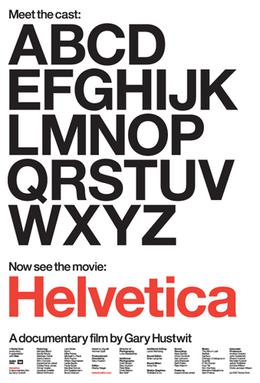
Every time I've mentioned to folks how excited I've been about the DVD release of Helvetica, the film about the font, not only have I received looks askance, but I've been told that my enthusiasm for this films officially cements my status as a dork. Even really dorky people have called me a dork. *sigh* Well, there IS the exception of the time I mentioned it to one of our graphic designers at work--she promptly pulled out a full-size publicity poster (see below) for the film (I particularly like this girl because she has a "No Comic Sans" bumper sticker tacked to her bulletin board. Here, here!).


So, I like fonts. What of it? When I worked for the UofA Poetry Center as an all-around grad student grunt, my favorite part of the job was designing all the posters for our readings. Matching font to visiting poet *almost* made it OK that I was making $7.50/hour. That said, I've always been something of a Garamond girl. Sadly, my font of choice is not an option here on Planet Blogger. I love it's little feathery serifs. I love that it's romantic in a Paris-is-the-City-of-Love kind of way. It's bookish and antique-y. It's ladylike. And ladylike-ness, by its very nature, contains the suggestion of its opposite. Like me wearing my Garamond t-shirt (yes, I own such a thing-- I wouldn't lie to you, my faithful flock) sans bra. Clearly, it's a great font.

Now, Helvetica, in and of itself, will never be a style to which I gravitate. It's Target, Crate&Barrel and though Ikea itself uses some other sanserif, it certainly embodies the Ikea ethic. It's ubiquitousness is, in fact, the very subject of the film. Moreover, though, the film discusses the ways in which a simple typeface can carry a pretty hefty emotional load. At its inception, the font was meant to denote an accessible, egalitarian, highly functional ideal. It's a little like a typographical outcropping of Bauhaus architecture. It's clean, simple and declarative. However, as it's every-freakin'-where, it quickly became associated with the fascism of American corporate culture-- a culture primarily responsible for its wide-ranging dissemination. Hence, Helvetica has both advocates and dissenters galore. Yes, friends, there is a great underworld of warring factions of typeface designers and graphic artists about which we can only imagine. Not only that, but all these folks speak in a manner wondrous colorful and metaphoric about the deeply subjective and associative qualities of any given font. Oh! Can I just tell you how much people who are both passionate and articulate about their chosen fields turn me on? And a liberal hand has spiced this film with bunches of just that sort of typographical expert.

Aside from all of the above, I think the real value of this film is that it offers a crash course in how the sign-signifier relationship works. And not just because we're looking at written language, which is, basically, a graphic representation of temporal sounds-- the basic fundament of the semiotic argument as a whole. To deny that there is a difference in meaning between the word... oh, I dunno, let's take "courtesan"-- written in Helvetica and the same word written in Garamond would denote a distinct lack of visual sensitivity on the part of the deny-er. And that difference only occurs because typeface, undeniably, bears some of the weight of meaning-making. Hence, the film becomes a mini-lesson-for-the-non-philosopher in aesthetic theory. And who among us DOESN'T wish we'd had more time to take philosophy of aesthetics classes when we were undergrads?

Jesus. I AM such a dork.

I leave you with this: participate in the non-fiction filmmaking renaissance TODAY! You'll be so glad you did.

I should be getting paid for these plugs.